

 April 2, 2025
  6 min read
  Share
Share Water heaters in residential buildings provide a nearly continuous supply of heated water for building users. However, water heaters must be properly installed and maintained to prevent an excess amount of internal hot water pressure that can result in a water heater leak, or even an explosion.

Damage from Water Heater Explosion
Because of contemporary water heater safety features and code regulations, water heater explosions are rare. There were 108 incidents involving domestic water heaters reported to the United States Consumer Product Safety Commission in 2022. Just two of those reports were related to water heater explosions that were caused by excessive internal hot water pressure.
Although water heater explosions are unusual, this kind of catastrophic event can cause an extensive amount of damage to a building. In some cases, exploding water heaters have become projectiles and were propelled through the roof of a house. If anyone is standing near an exploding water heater, they can be severely injured by scalding hot water and flying debris.
The most common type of domestic water heater has a cylindrical tank to heat and store the hot water. The capacity of most tank water heaters ranges between 30 gallons and 120 gallons. They are commonly powered by electricity, natural gas, or propane. Water that is piped to a water heater will flow into the storage tank until it is full. The heating source heats the water until it reaches the temperature setting on the tank thermostat. The temperature setting should prevent the discharge of overheated water at a user location that would scald or burn the user. Once the water reaches the temperature setting, the water heater will monitor the water temperature. If the temperature falls below the setting, the heating source will turn back on to bring the water up to the set temperature. As hot water is used, more water will enter the water heater, which will turn back on to raise its temperature.
As the water is heated, it expands, causing pressure to build up in the storage tank. If that pressure is not accounted for, there is an increased risk that the tank may leak or explode. That is why a proper water heater installation includes certain devices to relieve the excess water pressure.
A crucial safety device to relieve the excess water pressure is an expansion tank. A water heater expansion tank prevents pressure from building up in the plumbing system by receiving excess water as it expands.
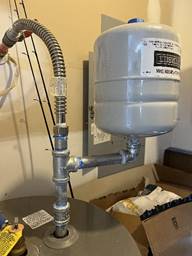
Water Heater Expansion Tank
The expansion tank is divided into two chambers. The top chamber is filled with compressed air and the lower chamber receives the heated water. When water heats up and expands, it flows into the expansion tank’s lower chamber. Between the chambers is a rubber diaphragm which absorbs the pressure of the heated water. When the water cools, the compressed air in the upper chamber pushes the water back into the system. This relieves excess pressure in the plumbing system and allows the expansion tank to receive the excess water and thereby regulates the water heater’s internal pressure.
However, expansion tanks may fail over time and lose their ability to control the heated water pressure. Here is a video of an expansion tank being cut apart to determine how it failed: https://www.youtube.com/watch?v=wURRf18ZraQ
The other safety device on a properly installed water heater is a pressure and temperature relief valve, sometimes called a tp valve. If the water heater is operating properly, the pressure in the water distribution system is not excessive, and the pressure and temperature relief valve is operating properly, then there should not be any water discharge from the relief valve. However, if water discharges from the relief valve, that is an indication of a either a plumbing system problem, a water heater problem, or that the relief valve is malfunctioning.
As the water in the tank is heated it expands, increasing the water pressure inside the tank. As the water becomes hotter, the pressure rises. If that increase in pressure is not relieved by the plumbing system or the expansion tank, the relief valve is triggered and releases a small stream of hot water until the tank pressure returns to a safe level.
If the relief valve fails for any reason, the pressure inside the tank will continue to increase. Eventually the increased pressure will reach a critical level and the tank will violently explode.
A water heater’s pressure and temperature relief valve should be tested periodically. There is a simple procedure for testing the relief valve, which involves pulling on the valve’s external handle for a few seconds, which will open the valve and allow water to flow through the valve. Releasing the valve handle will return the valve to a closed position. Testing the relief valve will ensure that the valve’s internal mechanisms are operating properly and will flush out any sediment debris build-up in the valve. Pressure and temperature relief valves typically have an attached label that explains the testing procedure. Testing a pressure relief valve should be performed wearing closed, water resistant footwear and leg coverings.

Water Heater Pressure Relief Valve & Handle
Here is a video that demonstrates the pressure and temperature relief valve testing procedure: https://www.youtube.com/watch?v=DoUL8N_e2NY
Using a professionally licensed master plumber is important in maintaining the safety of a water heater. There are numerous critical components in water heater installation and if anything fails, there is an increased risk of flooding or even an explosion. Proper water heater maintenance performed by a qualified licensed master plumber will significantly prevent any disasters in your home. Further, the International Plumbing Code, Chapter 5 and the International Residential Code, Chapter 28, have more information on code-complaint domestic water heater installation requirements and safety devices.
If you need assistance in a matter involving a scald from a water heater or water heater leakage and subsequent building damage CESI can help.